How to Design a Patrol Flag
Creating a patrol flag is fun art project, but a flag also has a larger purpose. A unique flag helps build identity, unity, and teamwork within a patrol. At meetings and on outings, it can be a tool for organization and leadership. It serves as a rallying point, a symbol of patrol pride, and helps foster a sense of belonging.
Last month we learned from Roman Mars that good flags follow five simple rules:
Keep It Simple. The flag should be so simple that a person can draw it from memory.
Use Meaningful Symbolism. The flag's images, colors, or patterns should relate to what it symbolizes.
Use 2 or 3 Basic Colors. Limit the number of colors on the flag to three which contrast well and come from a standard color set.
No Lettering or Seals. Never use writing of any kind or an organization's seal.
Be Distinctive But Related. Avoid duplicating other flags, but use similar layouts and conventions.
We’ll come back to these rules in a moment, but first let’s generate some ideas.
Step One
Brainstorm Ideas
Brainstorming is a collaborative exercise designed to give everyone a voice and generate as many different ideas as possible. There are many ways to do it, but here’s one that works for most situations:
- Choose a facilitator. This person’s job is to keep you on track and on time. For patrols, this could be good leadership practice for your assistant patrol leader.
-
Set a goal. If you’re coming up with ideas for a patrol flag, your goal might be
15–20 ideas from each Scout. The first
6–7
 ideas will be easy. Setting a stretch goal will push you to find new and unexpected ideas.
- Set a time limit. The less time you have the better. Pressure makes you think fast and doesn’t leave time for you to edit yourself. Remember, it’s quantity not quality at this stage. 5 minutes is a good limit.
- Be prepared with materials. Post-it notes work great. Give everyone a stack of 20 and have them write one idea per post-it. Doing it this way helps emphasize the goal (everyone should use up their entire supply) and helps you keep track of your progress.
- Best foot forward. The facilitator has everyone sort through their post-its and stick their 6 best ideas up on the wall. In a patrol of 8, that will be about 50 ideas altogether!
- Cast your vote. The facilitator gives everyone 10 red sticker dots. Each dot is a vote. Look at all the ideas. Put a dot on any idea that you like. You can put more than one dot on the ideas you like more (but try to vote for at least 3 ideas, 2 of which aren’t your own). Use all of your dots.
- Focus your energy. Keep the 5 ideas that received the most votes and take everything else off the wall. Now you're just looking at the best of the best. Have everyone say what they like best about one or two of the ideas. You can also suggest ways to improve or iterate on the ideas.
- Pick a direction At this point you’ll probably have come to a consensus around a few ideas that your patrol is most excited about. If you all agree on one, great! If there are two or three, that’s great too.
Resources
Good Flag / Bad Flag
How to design a great flag
The worst-designed thing you've never noticed
The TED Talk that started it all
The Good the Bad and the Ugly
From Canada to Pocatello
Materials
Tape or Push Pins
Pens / Pencils
Colored Markers or Pencils
Graphic Design Merit Badge
If you’re interested in using this exercise as part of the Graphic Design merit badge, get a Blue Card signed by your Scoutmaster.
This project is designed to satisfy requirements 3 and 4. We will cover requirements 1, 2 during our meetings. The final requirements, 5, 6, and 7 will be arranged for those wishing to earn the badge.
Step Two
Start Drawing
This is the fun part! Use the template below and fill each frame. That’s little 18 drawings, each one different in some obvious way than the others. The difference could be in style, composition, or content. Each frame is about 1" x 1½". This will keep your level of detail minimal and simulates what a full-size flag will look like from a distance.
In the example below, we’re sketching ideas for a fictional patrol called the Oak Patrol. Let’s imagine that the ideas that came out of our brainstorm were an oak leaf, a tree, and acorns. Sketching will turn these ideas into symbols with meaning. If you do your part—and your patrol members do theirs—you’ll have about 144 itty-bitty flag design to chose from!
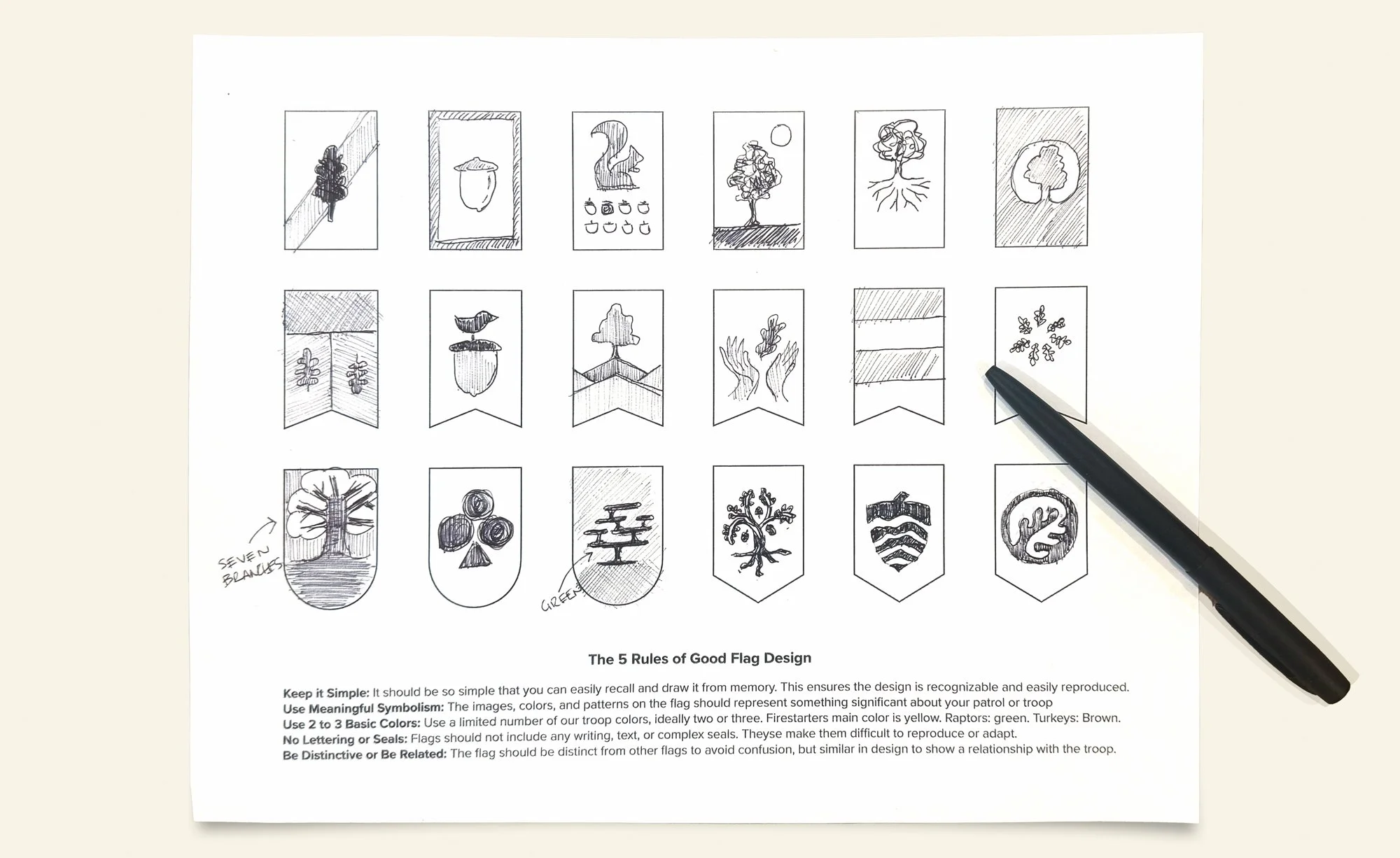
Explore the sketches above by hovering on the yellow dots. Download your own template here.
Notice how the first row of ideas are pretty obvious. That’s natural. You have to get the obvious ideas out of your head to make room for the more creative ones.
Step Three
Collaboration & Consensus
When all 18 frames are filled, tape or pin your sketches on the wall. Explore your fellow patrol members’ sketches as well.
When everyone’s drawings are up, the facilitator invites each Scout to come up and talk about two or three of their sketches (not all 18!). As each Scout takes a turn, you’ll probably start to notice some overlap. That’s good! This process should only take 7–8 minutes.
Now it’s time to make some tough decisions. As a patrol, you came up with 50 ideas that you then turned into 140+ sketches—but you only need one flag! As a group, you need to decide on the image, colors, and style that represents you best. Maybe that design is already up on the wall. Or maybe something on the wall inspires you to think of an interesting variation.
During this group discussion, focus on the things you like. Comments like, “I really the versions that have borders because of how they stand out” are helpful. Comments like, “That tree looks stupid” are unhelpful (and hurtful).
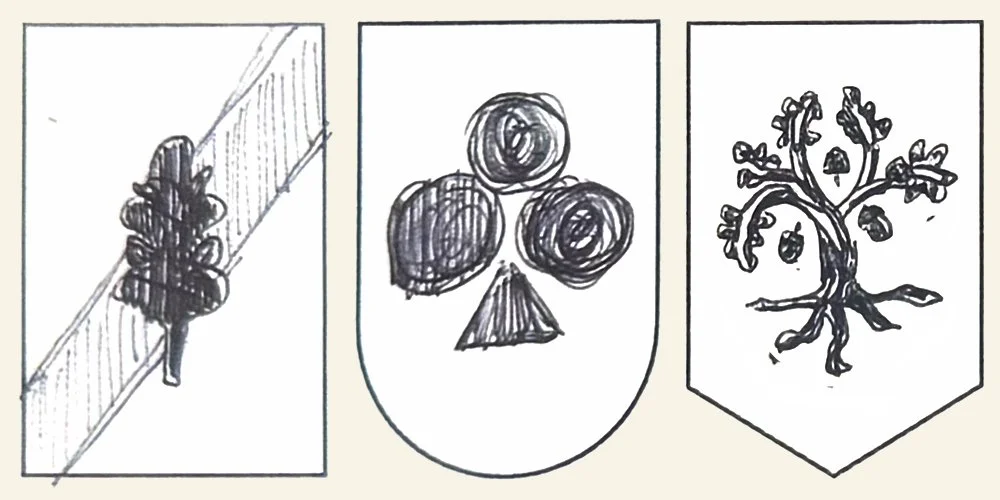
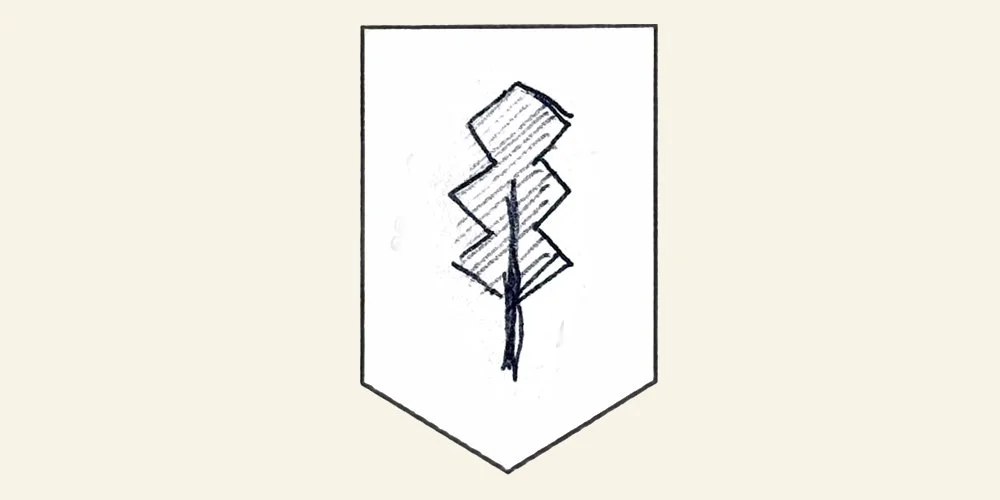
Let’s imagine that your patrol liked the idea of a single tree as their symbol. Several scouts commented that they prefer the simple geometric style more than the ornate organic style. Everyone liked the pointed banner more than rounded or square:
Combining those preferences might result in an iteration like this:
A word of caution: “designing by committee” is often a recipe for disaster. It’s usually better to empower one person to create the design, based on a set of shared goals. Too many cooks will spoil the broth, as they say. For similar reasons, it’s usually best to focus on one or two messages or symbols. Too many become confusing and messy-looking.
Step Four
Iteration
Okay…now that you’ve narrowed it down to one or two designs it’s time to iterate. This is where the magic happens! Instead of coming up with a lot of different ideas, you’ll create many variations of one idea. This is where you’ll make specific choices about color and style that take your sketch from concept to something more polished.
Pick one or two Scouts with good drawing skills to execute the designs. Everyone else can contribute with suggestions and by making sure you’re following the 5 rules of flag design. Use a full page template so you can refine the details.
Above: For our fictional Oak Patrol, let’s imagine we selected the abstract tree/leaf as our concept. These are some of the iterations we might explore. Using a grid (included on the template) can help with your arrangement. You can also do things like cut your designs out of paper to quickly rearrange elements (or use a design application on your computer if you know how to). The key is to keep asking your self “what if” questions. What if this tree was a triangle? What if it was round? What if I included a sun? Where else could I put the sun? Etc. Just keep making and experimenting. You’re bound to stumble on something interesting when you do.
Step Five
Final Production
Iterate as many times as you need to get to a place where it feels “just right.” Usually this means creating more variations than you think you need, then coming back to the one that’s your favorite. The final result might be drawn by one person, but it will represent the contributions from the whole patrol.
The final step is to get it made. There are professional flag makers that will take your design and print or sew it for you, or you can get the materials and craft it yourself. The choice is a matter of skill and budget.
No matter how you produce it, you will have worked as a team to create a unique symbol to display your patrol pride, and given a gift to future members of your patrol for years to come.
Congratulations!
Resources
Good Flag / Bad Flag
How to design a great flag
The worst-designed thing you've never noticed
The TED Talk that started it all
The Good the Bad and the Ugly
From Canada to Pocatello
Materials
Tape or Push Pins
Pens / Pencils
Colored Markers or Pencils
Graphic Design Merit Badge
If you’re interested in using this exercise as part of the Graphic Design merit badge, get a Blue Card signed by your Scoutmaster.
This project is designed to satisfy requirements 3 and 4. We will cover requirements 1, 2 during our meetings. The final requirements, 5, 6, and 7 will be arranged for those wishing to earn the badge.